
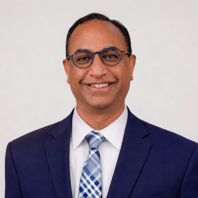
 Vikas Sachdeva serves as Chief Information Officer at HealthDrive Corporation, a healthcare organization delivering care to patients in long term care facilities across more than 20 states and over 4,000 facilities. With prior leadership roles spanning financial services, retail, AI driven digital engineering, and healthcare, Vikas has built a career focused on digital transformation that drives measurable business outcomes. At HealthDrive, his role centers on enabling clinicians with the right technologies, embedding responsible AI practices, strengthening security posture, and aligning innovation directly with improved patient care and operational performance.








Here’s a glimpse of what you’ll learn:
- How AI powered ambient listening and clinical assistance tools are augmenting providers in long term care settings
- Why responsible AI principles such as transparency, fairness, accountability, and human oversight are essential in healthcare
- How security and AI must evolve together to address protected health information risks
- Why AI should augment human workflows rather than replace employees
- How involving resistant stakeholders early turns them into champions of change
- Why transformation must start with business outcomes, not technology hype
- How data driven proof points reduce fear around automation initiatives
In this episode…
Vikas Sachdeva explains how HealthDrive leverages innovation to improve care delivery for underserved populations in long term care facilities. AI tools assist clinicians through ambient note capture, diagnosis support, and treatment guidance, allowing providers to focus more fully on patient interaction. He emphasizes that AI must remain augmentative rather than substitutive, particularly in healthcare where trust, ethics, and human accountability are foundational.
Security plays a parallel role in the transformation. Vikas outlines the importance of responsible AI, especially when working with protected health information. He discusses transparency, bias mitigation, reliability, and human oversight as non negotiable guardrails when deploying AI systems. He also addresses the reality that adversaries are leveraging AI as well, making automation and proactive security measures essential to stay competitive.
A major theme of the discussion centers on change management. Vikas shares a practical example of introducing intelligent document processing to automate unstructured data conversion. Initial resistance focused on trust and error rates, but by involving stakeholders early and comparing AI performance to existing human error rates, confidence grew. Error rates dropped from 17 percent to 4 percent, demonstrating measurable improvement rather than theoretical promise.
Throughout the episode, Vikas reinforces a consistent philosophy. Innovation is not about chasing trends. It is about identifying business outcomes first, then selecting the right technology to support them. AI becomes powerful when aligned with mission, patient care, operational efficiency, and employee empowerment.
Resources mentioned in this episode
Matthew Connor on LinkedIn
CyberLynx Website
Vikas Sachdeva on LinkedIn
HealthDrive Corporation Website
Sponsor for this episode...
This episode is brought to you by CyberLynx.com
CyberL-Y-N-X.com.
CyberLynx is a complete technology solution provider to ensure your business has the most reliable and professional IT service.
The bottom line is we help protect you from cyber attacks, malware attacks, and the dreaded Dark Web.
Our professional support includes managed IT services, IT help desk services, cybersecurity services, data backup and recovery, and VoIP services. Our reputable and experienced team, quick response time, and hassle-free process ensures that clients are 100% satisfied.
To learn more, visit cyberlynx.com, email us at help@cyberlynx.com, or give us a call at 202-996-6600.
Check out other related episodes:
Securing AI, Data, and Infrastructure at Government Scale with Steve Orrin
Building Resilient Security Programs Across Industries with Jess Vachon
Building Security After a Ransomware Wake Up Call with Brett Talmadge
Transcript:
Cyber Business Podcast – Vikas Sachdeva, CIO at Health Drive
Matthew: Matthew Connor here, host of the Cyber Business Podcast. Today we're joined by Vikas Sachdeva, CIO at Health Drive. Dr. Vikas, welcome to the show.
Vikas: Thank you. Thanks for having me, Matt.
Matthew: Thanks for joining us. Before we get too far in, a quick word from our sponsors.
[SPONSOR READ: This episode is brought to you by cyberlinks.com — that's Cyber-Lynx.com. Do you know if a hacker is in your system? Most people and most companies don't — until it's too late and the hacker has already done damage. A hacker's job is to bypass your security, so companies need a way to know when someone has gotten past their defenses. That's where Cyberlinks comes in. We've partnered with the best cybersecurity companies in the world to provide our clients with the best solutions at the best prices — whether it's managed SIEM, SOC, EDR, MDR, or XDR. We'll help you find the right solution at the right price. Find out more at cyberlynx.com — that's Cyber-Lynx.com.]
And now back to our show. Vikas, for those who aren't familiar, can you tell us about Health Drive and your role there as CIO?
Vikas: Absolutely. I currently serve as Chief Information Officer for Health Drive. Health Drive is an organization where we take care of patients living in long-term care facilities across 20-plus states and 4,000 different facilities. Our clinicians and providers go directly to those facilities and provide care to underserved populations who are in dire need of it. My role is making sure our providers have the right technology tools — and beyond that, it's about leadership, innovation in healthcare, and setting the right strategic direction for the company so we're driving real business outcomes. In this case, that means patient care. And I love it.
Matthew: I think you don't often hear "innovation" and "senior care" in the same sentence. Can we talk about that — the approach you've taken and some of the innovations happening there?
Vikas: I didn't think I'd start with the word AI, but AI and innovation really do go hand in hand these days. From an AI perspective, there are a lot of tools now available at the provider level. It starts with ambient listening — when a provider is in an encounter with a patient, AI can scribe the interaction in real time. Beyond that, it's about helping providers understand the diagnosis, assisting with or augmenting treatment plans, and guiding them toward the clinical pathway that's going to work best in that specific situation. There's a tremendous amount of innovation happening in this space — really helping providers understand patient needs and deliver the best possible care. AI is helping in many ways.
Matthew: You know, as we start talking about AI, I do tend to be a little security-focused — maybe it's the old Army guy in me, maybe it's just because it's such an important topic. What really excites me is AI applied to security. There are a million interesting AI projects and products launching right now, and I think a lot of them will filter out — just like every major tech boom, we'll see a lot of things tried and a lot of things fail. But when it comes to security, what I love is seeing AI applied the right way. Darktrace is my new favorite example — using the right kind of AI for the right kind of security problem. Their email security is exactly what you'd want: AI reading the email, understanding the user, working through it intelligently. Why isn't everybody doing this? When you contrast it with traditional email filtering, it's night and day. What worries me is everyone just bolting an LLM onto an existing product and calling it AI-powered — now you've opened yourself up to prompt injections and a whole range of other issues. I'm fascinated by where this is all going. From your perspective, how do you see AI playing a role in security?
Vikas: I'll answer that two different ways, Matt. The first is responsible AI. Any time you introduce AI into a business process, you need to make sure you're doing it ethically and responsibly. The principles we've instituted here start with deploying a fair, unbiased, inclusive, and reliable algorithm. Transparency matters — people need to understand what the output is and whether it can be trusted. And accountability matters — keeping the human in the loop, especially in healthcare, where we want AI to augment providers, not replace them.
But the bigger piece you were touching on is security. Fundamentally, security still plays a central role. In healthcare, we're dealing with protected health information, and we take the risk of any breach or data leak extremely seriously. Yes, we want to open up large language models and generative AI to drive better outcomes — but those systems have to be secure. That's the business angle to security.
And then there's the point you raised: bad actors are now using AI too — prompt injections and beyond. So we also have to leverage AI to understand those behaviors, to detect data loss, and to monitor how generative AI and LLMs are being used — including externally, since those tools are accessible to everyone. That means deploying the right technologies across the board: endpoint protection, data loss prevention, email security, XDR, and more. It all comes together to make sure the right security is in place at every layer.
Matthew: We're starting to see threat actors using AI not just to write more convincing phishing emails, but to fully automate attacks at lightning speed. It used to be that even if someone got into your network, you had some time. That window is shrinking fast. It's an arms race — they build up, we build up. I do believe the good guys will ultimately win. But we have to stay focused on it, keep implementing, keep advancing. Otherwise you're bringing a knife to a gunfight.
Vikas: Absolutely. These are the proactive measures that matter. We have to strive to be one step ahead of bad actors as much as possible. The reality is we're working with smaller teams, so we look for automation wherever possible — not just in detection but in remediation as well. Leveraging these modern tools gives us the edge we need.
Matthew: You've done a lot of transformation work — not just at Health Drive, but throughout your career. I think we're at a point where digital transformation, automation, and modernization are requirements, not options, for every IT and tech leader. Can you walk us through some of what you've done and share your perspective on modernization?
Vikas: Absolutely. I've spent my career across different organizations and industries — starting in financial services and insurance at Hartford Financial Services, where I led digital transformation; then at Edible Arrangements in consumer retail, modernizing the technology stack; then at Quantify, where the focus was AI-led digital engineering and transformation; and now Health Drive. One thing has been constant throughout: I'm always excited about the change and transformation that technology can bring — not for technology's sake, but to drive real business outcomes and better experiences. Whether that means better customer experiences at Hartford or Edible, or better patient care in healthcare, the constant is using technology as an innovation and growth engine that ultimately improves outcomes for people — whether those people are customers, patients, providers, or employees.
Matthew: I think that's exactly the right focus. It's easy for us IT people to get caught up in the cool new toys — and there's always a cool new toy. Look at how excited I get about Darktrace. But the real reason it matters is that we're focused on the end users, the people who make up the organization. And I think some business leaders right now are losing sight of the human element. They're asking where AI can improve the bottom line, drive efficiencies, and replace people. I don't think that's the right focus — but I'll yield to you on that.
Vikas: A few things come to mind. Let me start with the question I get most often: is AI going to replace humans? And I always say the same thing — AI is not going to replace humans. What's going to replace humans who aren't using AI is other humans who are. It's about augmenting our workflows, being more efficient and effective in how we work, not replacing human creativity and intelligence. I always look at AI and innovation as a capability — a way to make people better and drive better business outcomes. If I start from those principles, I'll always arrive at the right answer about whether AI is the right solution or not. I'd rather lead with a real business problem and solve it with the right technology. If that technology happens to be AI, great. If not, something else will do — as long as we're focused on the outcome.
Matthew: I love that. And I think one of the real challenges with all of this innovation and modernization is that it creates change — and people are generally afraid of change. Resistance to change. When it comes to leadership in these times, where we're going to see more change at a faster rate than ever before, what is your approach to helping people through it?
Vikas: Change is the only constant these days. We went through the dot-com era, the mobile era, the digital transformation era, and now AI. But I do agree that the pace of change right now is faster than anything we've seen before — and it's hitting the core of what people believe in. It's making people genuinely nervous.
My approach has been consistent across 20-plus years of driving change: there are people who will adapt very quickly, people who will resist most strongly, and everyone in between who will follow once someone else has gone first. The key is to build trust and involve people in the change upfront. The mistake we always make is introducing the change at the end — telling people, "Here's the new technology, it goes live tomorrow." If you make people part of the change from the beginning, so they feel like it's a change driven by them rather than done to them, they become part of the engine driving it themselves.
And critically — don't just focus on the early adopters. Focus equally on the people who will resist most. If you bring both groups in early, they become champions of the change. You don't have to keep pushing it yourself — they become your voice of reason with their peers, their customers, and their business partners.
Matthew: Let's get into the details of that, because dealing with resistant people can be genuinely frustrating. How do you actually turn a resistant naysayer into a cheerleader for change? Introducing it early helps, but early on they're still resistant. What's the process?
Vikas: Let me give you a concrete example rather than just theory. We were rolling out AI-powered intelligent document processing — taking unstructured paper and electronic documents and converting them into structured data to drive downstream business processes. Some people came in and said, "Can AI really be as trustworthy as our human team?" So instead of telling them, I got them into the project. We mapped out how they were doing the process today and how AI was going to improve it. Once they started to see that it would genuinely make them more efficient, they got excited — but that excitement alone isn't enough to carry a project through.
The second challenge came mid-project. The AI was delivering confidence rates slightly below 100%, and even though we had set that expectation upfront, people started saying, "This isn't 100% — it's going to impact our downstream processes." So we took a different angle: let's look at how many human errors are already in the system. Once we started capturing that data, we could show that the AI was actually performing better than the human process it was replacing. Error rates dropped from roughly 17% down to the 4% range. So: involve them upfront, understand their process, build and earn their trust, then put the numbers in front of them.
Matthew: And as you're saying that, I'm putting myself in the shoes of the resistant naysayer — and I think most of that resistance comes from fear. Fear of looking bad, fear of losing your job, fear of losing teammates. But as you walk them through the process — let's examine how we're doing it now, let's see how this improves things — suddenly they're thinking, "Wait, this is going to make my job so much better." It's like going from a broom to a vacuum. Now we can clean the floor so much faster. And I think everyone listening has a million examples of where someone was resistant and it turned out to be on us for not bringing them along properly. We just showed up on launch day and said, "It's here, it's great, you're going to love it" — when we'd been living with it for months and had all that context they didn't have.
Vikas: Exactly. And one thing I forgot to mention — a lot of times what helps most is showing people specifically what you're taking away from them. The tasks they find tedious, repetitive, soul-crushing. When they see that those things are going away and that their time will be freed up for higher-value work, they get even more excited about the change. That came to mind as you were describing it.
Matthew: Taking out the mundane and the tedious — making their day genuinely better. That's powerful.
And here's something I think about: so much of the fear around AI replacing jobs is amplified by our media environment. It goes back to the 24-hour news cycle — studies have traced a lot of our current media dysfunction back to the early 2000s, when the question became "how do we grab people's attention?" and the answer was fear-based stories. Now the algorithm makes it worse, funneling people into echo chambers of fear and anger. And when all you're hearing is that AI is going to replace your job, that fear becomes paralyzing. But when you listen to someone like you — when you hear the actual reality of how AI implementation works in practice — it's so much more reassuring. You don't want a robot serving your dinner. You don't want AI Tom Cruise hanging off the side of a plane. You want the geriatric 95-year-old Tom Cruise still doing it himself, because that's amazing.
Vikas: Exactly. And the media parallel actually connects to AI too — just like the news focuses on the negative, when people talk about AI in business, they focus on the 80 to 90% of AI projects that fail. But that's the wrong number to fixate on. From a leadership and innovation perspective, the right approach is to pick the right business problem, run a quick proof of concept, test and learn, prove it out — and then think about how to productionize and scale. The projects that are working well in production are actually driving real competitive differentiation. Focus on what's working, not what's failing. Glass half full versus glass half empty.
Matthew: I'm completely with you. And the media problem is only getting worse — even from reputable outlets, you get misleading headlines, and by the time you get to the actual data buried at the bottom, most people have already moved on. We used to get just the facts. Now with AI-generated video and audio deepfakes, you can't even trust what you're seeing. World leaders appear to say things they never said. I think we're going to need technology to solve what technology created — some kind of real-time fact-checking layer, whether it's a browser plugin or an app, that can immediately tell you: this story is misleading, and here's why. You still got the attention-grabbing headline, but now you're also getting the balanced picture.
Vikas: And that connects right back to security. Bad actors are already starting to leverage voice and video deepfakes in addition to the phishing emails we're used to defending against. There are companies working on identifying those fakes effectively. It's the same arms race — we continuously have to leverage technology to stay more secure and to identify deceptive content, whether it's showing up in social media or inside our businesses. We use technology effectively to counter it.
Matthew: Well, this has been so much fun. I think we could do this all day. Before we go, can you tell everybody where they can find out more about you and about Health Drive?
Vikas: Thank you, Matt — this was a great conversation. We covered so many topics: leadership, security, AI, innovation, and change management. For anyone who found value here and wants to connect, LinkedIn is the best place. Search Vikas Sachdeva and Health Drive — there are only a few of us, and at Health Drive, only one. And for Health Drive itself, you can visit ourhealthdrive.com. Take a look at our mission and how we're helping patients have a better quality of life. I'd love to answer any follow-up questions that come up.
Matthew: Fantastic. Until next time!
Vikas: Thank you, Matt.